




Sydney electricity prices rose more than 20% since 2023, and daytime solar feed-in tariffs have fallen below $0.05 per kWh in NSW meaning exporting solar power back to the grid pays very little. For Sydney homeowners, the smarter play in 2026 is storing your solar energy in a battery and using it yourself at night.
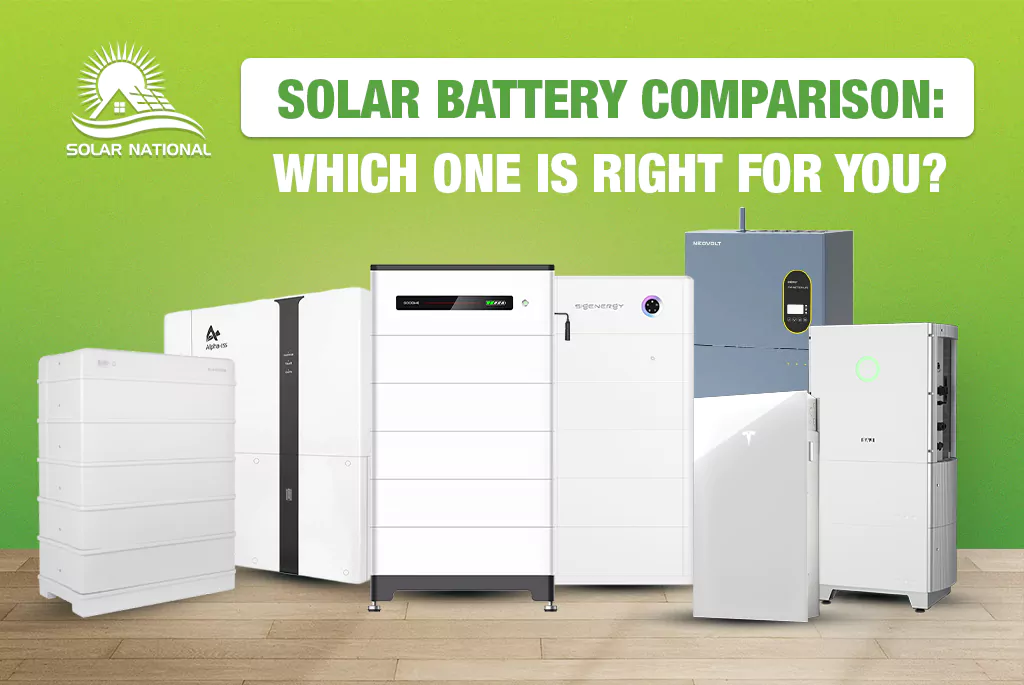
But with dozens of brands, five chemistries, and government rebates that changed in July 2025, choosing the right solar battery is genuinely confusing. This guide compares Tesla Powerwall 3, Sungrow SBR HV, Fox ESS, BYD Battery-Box, SAJ B2, and Sigenergy SigenStor on specs, price, and real-world suitability for Sydney homes. Solar National has installed all of these brands. This is our honest assessment.
Why Consider a Solar Battery in 2026?
Australia’s love affair with rooftop solar panels continues more than 3.5 million homes had solar by mid-2025. Several factors make 2026 a particularly attractive time to add battery storage:
- Federal Cheaper Home Batteries Program: The federal battery rebate (launched 1 July 2025) provides approximately 30% off the upfront cost of eligible batteries via additional Small-scale Technology Certificates (STCs).
- NSW VPP Incentive: From July 2025, NSW residents who join a Virtual Power Plant can claim ~$550 for a 10 kWh battery or ~$1,500 for a 27 kWh system — combinable with the federal rebate.
- Rising electricity prices: Day-time export rates have fallen below $0.05 per kWh in some states. A battery lets you self-consume your solar generation and avoid buying grid power at retail rates in the evening.
- Blackout protection: Extreme weather events have highlighted grid fragility. A battery with blackout capability keeps your fridge, lights and internet running during outages.
- Flexible finance available: For households concerned about upfront cost, Solar National offers flexible finance options to spread payments.
Understanding Solar Battery Technologies
Solar batteries use different chemistries, each with distinct advantages and drawbacks. For most Sydney homes, Lithium Iron Phosphate (LFP) is the recommended choice.
Lithium-Ion: The Two Main Sub-Chemistries
|
Type |
Characteristics |
Pros |
Cons |
|
LFP (LiFePO₄) |
Phosphate cathode. Excellent thermal stability. 100% DoD possible. |
6,000–10,000 cycles; >95% efficiency; handles Sydney heat safely. |
Slightly heavier; lower energy density than NMC. |
|
NMC |
Higher energy density than LFP. Lower cycle life. |
Compact; high power output; good discharge rates. |
~2,000–3,000 cycles; degrades faster in high temperatures. |
Lead-Acid Batteries
Traditional lead-acid batteries are inexpensive but have major drawbacks for grid-connected homes: short lifespan (3–7 years), only ~50% usable DoD, and lower efficiency (~80–85%). They are rarely recommended for modern Sydney residential installations.
Key Factors When Comparing Solar Batteries
- Usable capacity & DoD: Always compare usable kWh. A 10 kWh LFP battery at 100% DoD delivers the full 10 kWh. Always ask for the usable figure, not the nominal.
- Power output (kW): Continuous and peak output determines how many appliances run simultaneously during a blackout. Check whether the battery includes an integrated hybrid inverter or requires a separate one.
- Round-trip efficiency: Typically 88–95%. Higher efficiency means less wasted solar energy each day.
- Cycle life & warranty: LFP batteries last 6,000–10,000 cycles. Look for warranties covering both time (10 years) and a minimum energy throughput figure.
- Modularity: Modular batteries let you start small and expand later as your energy needs grow (e.g., adding an EV). Fixed-capacity systems are simpler but less flexible.
- DC vs AC coupling: DC-coupled systems (battery connected through a hybrid inverter) are more efficient for new installs. AC-coupled systems are simpler for retrofitting to an existing solar setup.
- Payback period: After the federal rebate, a 10 kWh installed system typically costs $6,000–$8,500. With rising electricity prices, payback is commonly 6–9 years for high evening-usage households.
Government Rebates & VPP Incentives
Federal Cheaper Home Batteries Program
The federal program provides ~30% off the upfront cost of an eligible battery through additional STCs. Key points:
- Batteries must be 5–100 kWh and installed by CEC-accredited installers
- Runs from 1 July 2025 to 2030; certificate values reduce each year
- Only the first 50 kWh of usable capacity earns certificates
- Can be combined with the NSW VPP incentive
Solar National is CEC-accredited and handles all rebate paperwork as part of your installation — you receive the discount upfront, not as a reimbursement later.
NSW VPP Incentive
From July 2025, NSW households joining an approved VPP provider receive a one-off payment tied to battery size (~$550 for 10 kWh). Approved providers include AGL, Amber, Origin, Engie and ShineHub. Review provider tariff rates and contract length before signing up.
Popular Solar Batteries in 2026 — Comparison Table
The following table summarises the leading residential batteries. Prices are indicative before rebates and vary by location and installer.
|
Battery |
Usable Capacity |
Chemistry |
Key Feature |
Approx. Cost (Before Rebate) |
Warranty |
|
Tesla Powerwall 3 |
13.5 kWh |
NMC | 90% DoD |
11.5 kW continuous; 15 kW peak; all-in-one inverter |
~$11,500–$13,600 |
10 yrs | 70% retention |
|
Sungrow SBR HV |
9.6–25.6 kWh |
LFP | 100% DoD |
3.2 kWh modules; 8,000-cycle warranty; IP55 |
~$9,500 for 12.8 kWh |
10 yrs | 8,000 cycles |
|
Fox ESS EQ4800 |
4.66–41.93 kWh |
LFP | 100% DoD |
Most modular (1–9 units); >95% efficiency; IP65 |
~$9,500–$11,000 for 9 kWh |
10–12 yrs |
|
BYD Battery-Box HVM |
4–256 kWh |
LFP | 100% DoD |
10,000-cycle warranty; works with many inverters |
~$10,000 for 12 kWh |
10 yrs | 10,000 cycles |
|
SAJ B2 / HS2 |
5.12–25.6 kWh |
LFP | 100% DoD |
Most affordable; off-grid mode; blackout protection |
$5,000–$6,500 for 10 kWh |
10 yrs |
|
Sigenergy SigenStor |
5–48 kWh |
LFP | 100% DoD |
Built-in EV charger; 0ms backup switchover; AI management |
~$11,500 for 13 kWh |
10 yrs | 0ms backup |
Cost Per kWh (After Federal Rebate)
Average battery-only systems cost approximately $826 per kWh for 10 kWh after the federal rebate. Battery-plus-hybrid-inverter systems average $986 per kWh. Larger systems cost less per kWh because fixed installation costs are spread across more storage.
To spread the cost with manageable repayments, explore Solar National’s Handypay Finance options.
Detailed Reviews of Each Solar Battery
1. Tesla Powerwall 3
→ View Tesla Powerwall 3 at Solar National
Tesla’s third-generation Powerwall is an all-in-one battery with an integrated hybrid inverter. With 13.5 kWh usable capacity and 15 kW peak output, it runs large appliances including ducted air-conditioning during a blackout. It supports stacking up to four units for 54 kWh.
|
Specification |
Details |
|
Usable Capacity |
13.5 kWh | Stack to 54 kWh (4 units) |
|
Chemistry |
NMC | 90% DoD |
|
Continuous / Peak Output |
11.5 kW continuous | 15 kW peak |
|
Round-Trip Efficiency |
89% |
|
Monitoring |
Tesla app — industry-leading interface |
|
Approx. Price |
$11,500–$13,600 installed (before rebate) |
|
Warranty |
10 years | 70% capacity retention |
Best for: Sydney homeowners who want premium all-in-one simplicity, strongest brand backing, and highest peak output for large homes.
2. Sungrow SBR HV
→ View Sungrow Battery at Solar National
The Sungrow SBR HV uses LFP cells in 3.2 kWh modules. Households can start at 9.6 kWh and grow to 25.6 kWh. It requires a Sungrow hybrid inverter, which enables DC-coupling for higher system efficiency. The 8,000-cycle warranty is the strongest in its price tier.
|
Specification |
Details |
|
Usable Capacity |
9.6–25.6 kWh (3.2 kWh modules) |
|
Chemistry |
LFP | 100% DoD |
|
IP Rating |
IP55 — indoor or outdoor |
|
Cooling |
Passive — no fans or moving parts |
|
Cycle Guarantee |
8,000 cycles |
|
Approx. Price |
~$9,500 for 12.8 kWh (before rebate) |
|
Warranty |
10 years | 8,000-cycle guarantee |
|
Required Inverter |
Sungrow hybrid inverter |
Best for: Households wanting strong mid-range value, modular expansion, and the best cycle-life warranty at this price point.
3. Fox ESS EQ4800 — Solar National’s Value Pick
→ Read the Full Fox ESS Battery Review
Fox ESS has become one of the fastest-growing battery brands in Australia. As a Forbes Global Unicorn (valued at over US$1 billion), it is financially stable with a dedicated Melbourne support office. It is the most modular battery in this comparison — start with one 4.66 kWh module and expand to nine as your needs grow.
|
Specification |
Details |
|
Usable Capacity |
4.66 kWh per module | Up to 41.93 kWh (9 modules) |
|
Chemistry |
LFP | 100% DoD |
|
Round-Trip Efficiency |
>95% |
|
Cycle Life |
6,000+ cycles (~15–16 years daily use) |
|
IP Rating |
IP65 — dust-tight and water-resistant |
|
Certifications |
IEC 62619, UN38.3, EMC, CEC Approved |
|
Approx. Price |
$9,500–$11,000 for 9 kWh | ~$6,500–$7,700 after rebate |
|
Warranty |
10 years (12 years on CQ6 model) |
Best for: Homeowners wanting the best value per kWh, maximum flexibility to start small and expand, and a well-backed brand with Australian support.
4. BYD Battery-Box Premium HVM
→ View BYD Solar Battery at Solar National
BYD’s modular Battery-Box HVM is the most scalable residential battery on the market. Each 2.56 kWh module stacks from 4 kWh all the way to 256 kWh, and the system is compatible with many third-party inverters — SMA, Fronius, GoodWe, SolarEdge — giving you genuine inverter flexibility.
|
Specification |
Details |
|
Usable Capacity |
4–256 kWh (2.56 kWh modules) |
|
Chemistry |
LFP | 100% DoD |
|
Inverter Compatibility |
SMA, Fronius, GoodWe, SolarEdge |
|
Cycle Guarantee |
10,000 cycles — market-leading |
|
Approx. Price |
~$10,000 for 12 kWh (before rebate) |
|
Warranty |
10 years | 10,000-cycle guarantee |
Best for: Large Sydney homes wanting maximum scalability, inverter flexibility, and the strongest cycle warranty available in the residential market.
5. SAJ B2 / HS2 Series
→ View SAJ Solar Battery at Solar National
SAJ is the most affordable LFP battery option in Solar National’s range. The B2/HS2 scales from 5.12 kWh to 25.6 kWh and supports off-grid mode with blackout protection included as standard. At $5,000–$6,500 for a 10 kWh system, it is one of the most accessible entry points into battery storage.
|
Specification |
Details |
|
Usable Capacity |
5.12–25.6 kWh (5.12 kWh modules) |
|
Chemistry |
LFP | 100% DoD |
|
Off-Grid / Blackout Mode |
Yes — included as standard |
|
Approx. Price |
$5,000–$6,500 for 10 kWh (before rebate) |
|
Warranty |
10 years |
Best for: Budget-conscious Sydney homeowners who need essential storage with blackout protection, without paying for premium features they will not use.
6. Sigenergy SigenStor
→ View Sigenergy Battery at Solar National
Sigenergy’s SigenStor is the most innovative battery on the market — combining a modular LFP battery (5–48 kWh), hybrid inverter, bi-directional EV charger, and optional hot water storage in a single integrated system. Its zero-millisecond backup switchover and AI-powered energy management are genuinely unique features.
|
Specification |
Details |
|
Usable Capacity |
5–48 kWh modular |
|
Chemistry |
LFP | 100% DoD |
|
Integrated Inverter |
Yes — no separate inverter required |
|
EV Charger |
Built-in bi-directional charger |
|
Backup Switchover |
0 milliseconds — fastest in class |
|
Energy Management |
AI-powered optimisation |
|
Approx. Price |
~$11,500 for 13 kWh (before rebate) |
|
Warranty |
10 years |
Best for: Tech-forward Sydney homeowners planning for EV ownership who want a single integrated energy hub rather than separate components.
Solar National also supplies Neovolt and AlphaESS batteries for households with specific requirements.
Solar Battery Cost Analysis & Payback Period
|
Specification |
Details |
|
Battery modules (10 kWh) |
$800–$900 per kWh after federal rebate = $8,000–$9,000 |
|
Hybrid inverter (if required) |
$2,000–$3,000 depending on brand |
|
Installation, wiring & switchboard |
$1,500–$3,500 depending on complexity |
|
Total (10 kWh with inverter, before rebate) |
$9,000–$12,000 typically |
|
After 30% federal rebate |
$6,000–$8,500 (approximate) |
|
Additional NSW VPP incentive |
~$550 for 10 kWh battery |
|
Typical payback period (2026) |
6–9 years for high evening-usage Sydney homes |
Other Considerations Before You Buy
Energy usage patterns: A typical 3–4 bedroom Sydney home uses 8–12 kWh overnight. Size your battery to match night-time usage, not total daily consumption.
Climate: LFP batteries handle Sydney’s summer heat far better than NMC. Install in a shaded, ventilated area — never in direct sunlight.
Retrofit vs new build: For existing solar systems, an AC-coupled battery (e.g. Tesla Powerwall 3) is the simplest retrofit. For new solar panel installations, a DC-coupled hybrid inverter and battery system is more efficient.
Home vs business: This guide focuses on residential solar needs. For commercial solar applications, BYD and Sigenergy scale most effectively — contact Solar National for a separate commercial assessment.
Already have a Solis inverter? Our Solis Solar Inverter Review explains which batteries are compatible with Solis hybrid models.
Conclusion: Which Solar Battery Should You Choose?
There is no single best solar battery. The right choice depends on your budget, energy usage, and future plans:
- Tesla Powerwall 3 — Premium all-in-one, highest peak output, strongest brand
- Sungrow SBR HV — Best mid-range value, market-leading 8,000-cycle warranty
- Fox ESS EQ4800 — Best value per kWh, most modular, Solar National’s everyday recommendation
- BYD Battery-Box HVM — Most scalable, best-in-class 10,000-cycle warranty
- SAJ B2/HS2 — Most affordable entry point for essential storage
- Sigenergy SigenStor — Best for tech-forward households planning EV integration
Whatever your choice, the combination of the federal rebate, NSW VPP incentive and rising electricity prices makes 2026 a compelling year to invest in solar battery storage.
Solar National — Sydney’s trusted, locally owned CEC-accredited installer — can design a tailored solution, handle all rebate paperwork, and ensure a high-quality installation. Book a free appointment today or call 1300 179 949.
Frequently Asked Questions:
What is the best solar battery in Australia in 2026?
There is no single answer — it depends on your budget and goals. For value and modularity, Fox ESS EQ4800 leads. For premium features, Tesla Powerwall 3 is top-rated. For cycle-life warranty, Sungrow SBR HV (8,000 cycles) and BYD HVM (10,000 cycles) are the strongest. Contact Solar National for a personalised recommendation based on your electricity bills.
How much does a solar battery cost in Sydney after the rebate?
After the federal Cheaper Home Batteries Program rebate (launched July 2025), a 10 kWh installed system typically costs $6,000–$8,500. NSW households can also claim the VPP incentive (~$550 for 10 kWh) on top of the federal rebate.
Is LFP or NMC better for Australian conditions?
LFP is generally better for Australian homes. It handles high temperatures more safely, lasts far longer (6,000–10,000 cycles vs ~2,000–3,000 for NMC), and supports 100% DoD. For Sydney’s hot summers, LFP’s thermal stability is a clear advantage.
Can a solar battery power my home during a blackout?
Not automatically — it depends on system design. Tesla Powerwall 3 and Sigenergy SigenStor include backup as standard. Fox ESS, Sungrow and BYD require the correct inverter and backup switchboard configuration. Solar National confirms backup requirements with every customer before installation.
What size battery do I need for a Sydney home?
A typical 3–4 bedroom Sydney home uses 8–12 kWh overnight. A 10 kWh battery covers most of this. Homes with air-conditioning, pool pumps or EVs may need 15–20 kWh. Solar National analyses your interval meter data to recommend the exact right size — avoiding over-spending or under-sizing.
How long does a solar battery last?
Modern LFP batteries last 15–25+ years in real-world use. All leading brands offer a 10-year manufacturer warranty guaranteeing minimum 70% capacity retention. BYD (10,000 cycles) and Sungrow (8,000 cycles) offer the strongest throughput guarantees. At one cycle per day, 10,000 cycles equals approximately 27 years.